
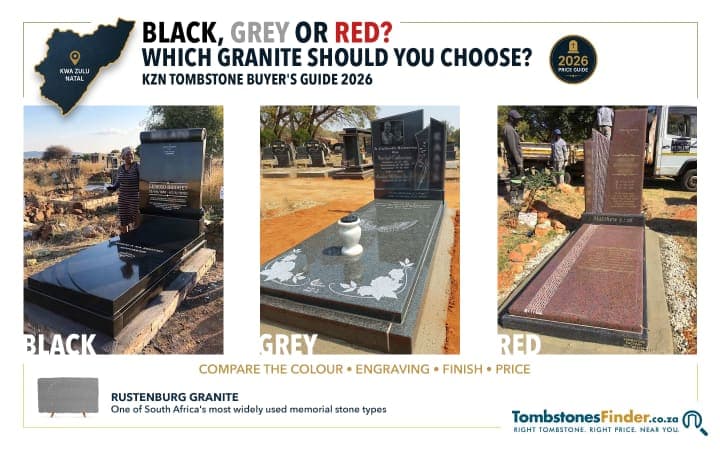
Granite Tombstones in KZN: Which Granite Colour and Type Should You Choose?
Jul 27, 2026
Black, grey, red or a combination? The granite you choose can affect the appearance, engraving and price of a tombstone. This KZN buyer’s guide explains the differences and what to consider before making your choice.
Granite Tombstones in KZN: Which Granite Colour and Type Should You Choose?
You have found a tombstone design that you like. Then the manufacturer asks:
“Which granite would you like?”
Black? Grey? Red or rose? Perhaps a combination of two colours?
For many families buying a tombstone in KwaZulu-Natal, this is where things can become confusing. Two tombstones can have almost exactly the same design but look completely different simply because of the granite used.
The choice is not only about colour either. The granite can influence the overall appearance of the memorial, how clearly the lettering and artwork stand out, the available finishes and potentially the final price.
This guide explains the main things to consider when choosing granite for a tombstone in KZN.
Why Is Granite Used for Tombstones?
There is a good reason you see so many granite tombstones in South African cemeteries.
Granite is a dense, hard natural stone that can withstand long-term outdoor exposure while also taking a highly polished finish. Its structure also makes it suitable for the engraving, sandblasting and detailed lettering used on memorials.
For a family, think of granite as providing both the structure and the appearance of the memorial.
It needs to survive outdoors for many years, but it also needs to provide a suitable surface for the deceased's name, dates, messages, symbols and other personalisation.
Granite gives tombstone manufacturers considerable flexibility to achieve both.
The Most Important Thing to Understand: Granite Is a Natural Material
Granite is not manufactured like a sheet of plastic or painted steel.
It comes from the earth.
That means natural variations in grain, mineral pattern and colour are normal. Even pieces sold under the same granite name may not look absolutely identical.
This is important when shopping from photographs.
A photograph on a website or catalogue is useful for choosing the general appearance, but before placing an order you can ask the manufacturer:
“Can you show me a sample of the actual granite that will be used for my tombstone?”
If your memorial combines several pieces, you can also ask whether those pieces will have a reasonably consistent appearance.
Black Granite Tombstones
Black and very dark granite create one of the most recognisable modern tombstone appearances.
A highly polished dark tombstone can have an almost mirror-like appearance, particularly when combined with gold, white or light-coloured lettering.
Why choose black granite?
Black granite can be a good option if you want:
- A bold, formal appearance
- Strong contrast between the stone types used and lettering
- Detailed engraving
- A modern or premium-looking memorial
- Portrait or image work
- Gold or light-coloured inscriptions
One of the biggest advantages is contrast.
Imagine drawing with a white pencil on black paper rather than grey paper. The white marks immediately stand out.
A similar principle applies to memorial engraving. Dark, relatively uniform stone provides excellent contrast for inscriptions, and very dark granite can be particularly suitable for detailed etched images and portraits.
One consideration with black granite
A highly polished dark surface can make dust, dried water marks and other surface dirt easier to notice than on some lighter, patterned stones.
That doesn't necessarily make black granite difficult to maintain; it simply means marks can be more visible against the dark polished surface.
What Is Rustenburg Granite?
This is a name South African tombstone buyers are likely to encounter.
Despite commonly being called Rustenburg granite, the stone sold under names such as Rustenburg, Nero Impala and Impala Black is geologically a norite quarried from the Bushveld Igneous Complex around Rustenburg in North West Province.
For a tombstone buyer, the geology isn't particularly important.
What matters is what it looks like and why it is used.
Rustenburg stone typically has a dark charcoal-to-black appearance with fine grey or silver mineral flecks. When polished, it develops the deep, dark appearance commonly seen on South African tombstones.
It is also locally quarried rather than being an imported stone, and is widely used for tombstones and memorial work in Southern Africa.
Why is Rustenburg granite popular for tombstones?
It provides a useful combination of:
- Dark appearance
- Good engraving contrast
- Consistent-looking grain
- Durability
- Good polished finish
- Local South African availability
It can therefore be worth specifically asking a manufacturer: ** “Is this Rustenburg granite, or another type of black granite?”**
Don't assume every dark tombstone you see is made from exactly the same stone.
Absolute Black and Other Very Dark Granites
You may also be offered granite described as Absolute Black, Premium Black or another commercial name.
These stones generally aim for a deeper and more uniform black appearance than the silver-flecked charcoal appearance associated with Rustenburg stone.
Absolute Black can create particularly strong contrast with white or gold-filled lettering and is often positioned as a more premium memorial option.
However, names used for stone can vary between suppliers.
Instead of choosing solely because something is called “Premium Black”, ask to see the stone.
Compare:
- How black it actually is
- How visible the grain is
- The consistency of the colour
- The polished finish
- How lettering looks on it
- The price difference
Then decide whether the difference matters enough to you to pay more.
Grey Granite Tombstones
Not every family wants a completely black memorial.
Grey granite can create a softer and more traditional appearance.
Depending on the particular stone, grey granite can range from relatively light grey through to charcoal and can contain visible natural mineral patterns.
Grey granite may suit you if you want:
- A lighter memorial
- A traditional stone appearance
- Visible natural grain
- Less of a mirror-black finish
- Contrast between different granite colours
Grey can also work particularly well as part of a two-colour tombstone.
For example, a manufacturer may combine a grey base or slab with a darker headstone.
This brings us to an important point: ** You don't necessarily have to choose only one colour.**
Red, Rose and Coloured Granite Tombstones
Red, rose and reddish-brown granite can give a memorial a completely different character from black or grey.
Rather than the formal appearance of polished black stone, red or rose granite introduces warmer natural tones.
Families may choose coloured granite because:
- They prefer a warmer appearance
- They want the tombstone to look different
- It has personal significance
- It complements another granite colour
- It suits the particular tombstone design
The natural pattern can also become part of the design.
However, availability varies between manufacturers, so if you find a particular colour you like, ask for the exact granite name rather than simply asking for “red granite”.
What About Two-Tone and Mixed-Colour Tombstones?
This is where tombstone design becomes particularly interesting.
A tombstone does not have to be completely black, grey or red.
Manufacturers can combine contrasting granites within one memorial.
For example: ** Black + Grey
Black + Red
Grey + Black**
The darker granite could be used for the headstone where the main inscription appears, while another colour is used for the base, kerbs or other elements.
Think of this like choosing finishes when designing a kitchen.
The cabinets, countertops and handles don't all need to be the same colour. Contrast can actually make the overall design more interesting.
The same design principle can work with a tombstone.
Which Granite Is Best for Engraving?
There isn't one answer because it depends on the type of engraving and design you want.
However, contrast matters.
Dark granite generally provides excellent visibility for lighter lettering because the inscription contrasts strongly against the polished surface. Rustenburg granite is specifically valued in memorial applications for the contrast it provides for engraving and sandblasted lettering.
If you want detailed artwork or a portrait etched directly into the stone, very dark granite can be especially effective because the etched areas appear lighter against the polished black surface.
Before choosing, ask your manufacturer to show you completed examples of:
- Names and dates
- Longer messages
- Religious symbols
- Decorative artwork
- Portraits
- Gold or light-coloured lettering
Seeing an actual finished tombstone is much more useful than looking at a small raw granite sample.
Which Granite Is Best for a Photograph?
First decide what type of photograph you want.
There is a difference between a photograph added to a tombstone using a ceramic or similar photo product and a portrait actually etched into the granite.
If you want a detailed monochrome portrait etched directly into the stone, very dark granite generally provides better visual contrast.
If the photograph is being applied using another method, the granite colour may be less important.
Tell the manufacturer what you want before selecting the stone.
Does Granite Colour Affect the Price of a Tombstone?
It can.
But be careful about assuming that colour alone determines the price.
The final price of a tombstone can also be affected by:
- Whether the granite is locally sourced or imported
- Availability of the particular stone
- Size of the tombstone
- Amount of granite required
- Thickness
- Design complexity
- Polishing and finishing
- Engraving
- Photographs and artwork
- Transport
- Foundation and installation
Locally quarried Rustenburg stone is widely used in the South African memorial industry, while certain imported or specialised dark and coloured stones can cost more.
Therefore, if two similar tombstones have significantly different prices, don't simply ask: ** “Why is this one more expensive?”**
Ask:
“What granite is used in each tombstone, and what else is different between the two quotations?”
That gives you a much more useful comparison.
Does More Expensive Granite Mean a Better Tombstone?
Not automatically.
An expensive imported colour may cost more because of sourcing, transport, availability or appearance. That does not automatically mean it is the right choice for your family.
Likewise, locally sourced stone should not automatically be regarded as inferior simply because it may cost less.
Rustenburg stone, for example, is quarried in South Africa and is extensively used for memorial applications locally and internationally.
A better question is:
“Am I paying extra for something that matters to me?”
If you prefer the appearance of a particular premium black or coloured granite, the additional cost may be worthwhile.
If you cannot see enough difference to justify it, another granite may provide better value for your budget.
Ok. I did this a few months back. But I cant remeber a thing
Tue, May 12 at 9:11 AM Ok. Im confused. This is where i am now. Please give me the next step. Please use anologies I can visualize to explain concepts or things. It helps as I am very left brained.
Wed, May 13 at 11:04 AM
Wed, May 13 at 12:18 PM
Is this correct
Does this look like it should?
Mon, May 18 at 11:37 AM can you summarize and put this into lamens terms. this is one our Google Analytics pages
Mon, May 18 at 12:40 PM And this:
Generated image: Tombstone pricing guide for KZN 2026
Generated image: Tombstone pricing guide for KZN
Mon, Jul 6 at 7:56 AM Can you tell me what these numbers and metrics mean
Monday 10:22 AM So I have done two blogs now for Tombstonesfinder to better out google ranking. It seems to be working somewhat. I need another topic for this weeks blog. Remember, it needs to be relevant to KZN and people in KZn and what they searching for when it comes to purchasing a tombstone. Please see what topics related to tombstones people are searching or asking about and give me 10 possible blogs i could write on. Remember it needs to matter for the end user and help my google position
Ok, lets do 1. What Is Included in the Price of a Tombstone in KZN? Hidden Costs to Ask About. Please write me a blog with the best knowledge you have on the topic. Also a suggest for what Blog picture to use. Also attached the the back-end fields I use so please give me the matching info for all the fields you know you can fill
Generated image: What's included in a tombstone price?
Today 11:28 AM I need to write another blog for this week. I think want to focus on this one: 2. Granite Tombstones in KZN: Which Type of Granite Should You Choose?
Yes. I think this is a strong choice for Blog #4, and I'd write it next.
I did a fresh check of current South African tombstone information before answering. There is enough genuine buyer intent around granite type, colour, quality, durability, engraving and price to build a useful article rather than a thin SEO page.
The key is to change the title slightly. Recommended title
Granite Tombstones in KZN: Which Granite Colour and Type Should You Choose?
I prefer that over simply "Which Type of Granite?" because an ordinary customer is much more likely to think:
"Do I want black, grey or red granite?"
than:
"What geological variety of granite should I purchase?"
And that's exactly how we should approach the article — from the family's point of view, not the stonemason's point of view. The article should answer these questions
Why is granite commonly used for tombstones?

What's the difference between black, grey and red/rose granite?

Why do some black tombstones cost more than others?

Is darker granite better for engraving?

Which granite works best if I want a photograph or detailed portrait?

Does granite colour affect maintenance?

Does granite type affect the price?

What should I ask the manufacturer about granite quality?

Which granite is best for KZN conditions?

Is expensive granite actually worth paying extra for?
There's good substance behind these questions. South African memorial suppliers currently offer black, grey, rose/red and other granite varieties, and Rustenburg-type dark granite remains particularly important in the local memorial market.
One particularly useful point for consumers is engraving contrast. Dark, relatively uniform granite gives lettering strong contrast, while detailed etching/portrait work can be particularly effective on black granite. I would structure it like this
Think of the article as taking the customer into a granite showroom, except we're doing the explaining before a salesperson gets involved.
Opening: "You've chosen a tombstone design you like. The manufacturer then asks: Which granite would you like? Black? Grey? Rose? And why does one apparently cost more than another?"
Then:
-
Why is granite used for tombstones? Explain durability, hardness, weather resistance and ability to take a polished finish and engraving. Granite is a very durable common memorial material and holds inscriptions well.
-
Black granite tombstones Appearance, engraving visibility, premium-looking designs, photographs/etching and potential price differences.
-
Grey granite tombstones More traditional/lighter appearance, practical considerations, combinations with black granite, etc.
-
Red/Rose granite tombstones Why someone might choose it, warmer appearance, combining colours, availability.
-
What is Rustenburg granite? This is worth having as its own section because it's South African and locally relevant. Rustenburg/Nero Impala is described as dark charcoal-to-black with fine grey/silver mineral characteristics and is widely used for memorials in South Africa.
-
Does granite colour affect engraving?
-
Does granite type affect the price of a tombstone?
-
Which granite is easiest to maintain?
-
What should I look for when comparing granite quality?
-
Which granite should I choose for my tombstone in KZN?
And this last section is where TombstonesFinder becomes useful rather than the article just ending.
We can say something along the lines of:
There isn't one granite colour that is best for every family. Your choice should depend on the appearance you prefer, the tombstone design, the type of engraving or portrait you want and your budget.

A useful starting point is to compare completed tombstones in several granite colours before deciding.
Then:
Browse granite tombstones from KZN manufacturers on TombstonesFinder →
That moves the Google visitor from research into your actual marketplace. Even better: connect it to the previous blogs
You now have the beginnings of something quite valuable:
How Much Does a Tombstone Cost in KZN? ↓ What's Included in the Price? ↓ Which Granite Should I Choose? ↓ How Do I Choose a Tombstone Manufacturer? ↓ View actual tombstones
That's becoming a proper KZN tombstone buyer's guide, rather than four unrelated blog posts.
And Google can understand those relationships through the internal links. One thing I would NOT put in this article
I found search results making claims such as "Grade 1 granite", "Grade 2 granite" and precise durability rankings. Some also give very specific price differences between named granite types. I'm not confident enough that those classifications are standardized across the South African tombstone industry to present them to your customers as established fact.
Instead, I'd teach the buyer to ask:
"What exact granite are you quoting me for, where does it come from, and can I see a finished tombstone made from the same stone?"
That's far more useful.
I'd also add a simple comparison table in the article: Granite choice Appearance Good for Consider Black/Dark Bold, polished, formal High-contrast lettering & detailed designs Can be a premium option Grey Lighter, classic Traditional designs Engraving contrast differs Red/Rose Warm, distinctive Families wanting something different Availability/design compatibility Mixed colours Contemporary/custom More elaborate memorials Design and cost can increase
Visually, this could be your best blog image yet: three nearly identical tombstones side-by-side — black, grey and rose/red granite — with the KZN outline and the headline:
BLACK, GREY OR RED? WHICH GRANITE SHOULD YOU CHOOSE? KZN Tombstone Buyer's Guide 2026
That immediately communicates the question the article answers.
Today 12:35 PM Ok. As before please write me the entire blog. Please use all the access and info you can gather to write the most relevant blog on the subject and to whom its targeted towards. Remember all the fields and details required. Please see attached. Also your recommendation on what pic to use to add that much more value to the blog
Yes. For this article I’d target a KZN family who has already decided they want a granite tombstone but is now looking at black, grey, red/rose and mixed-colour tombstones and wondering what the actual difference is.
I’ve also avoided questionable claims such as universal “Grade 1–5 granite” classifications. Instead, the article focuses on things a buyer can actually see, compare and ask a manufacturer about.
Below is everything mapped to your Strapi fields. TITLE
Granite Tombstones in KZN: Which Granite Colour and Type Should You Choose? EXCERPT
Black, grey, red or a combination? The granite you choose can affect the appearance, engraving and price of a tombstone. This KZN buyer’s guide explains the differences and what to consider before making your choice. CONTENT / newStrapiContent Granite Tombstones in KZN: Which Granite Colour and Type Should You Choose?
You have found a tombstone design that you like. Then the manufacturer asks:
“Which granite would you like?”
Black? Grey? Red or rose? Perhaps a combination of two colours?
For many families buying a tombstone in KwaZulu-Natal, this is where things can become confusing. Two tombstones can have almost exactly the same design but look completely different simply because of the granite used.
The choice is not only about colour either. The granite can influence the overall appearance of the memorial, how clearly the lettering and artwork stand out, the available finishes and potentially the final price.
This guide explains the main things to consider when choosing granite for a tombstone in KZN. Why Is Granite Used for Tombstones?
There is a good reason you see so many granite tombstones in South African cemeteries.
Granite is a dense, hard natural stone that can withstand long-term outdoor exposure while also taking a highly polished finish. Its structure also makes it suitable for the engraving, sandblasting and detailed lettering used on memorials.
For a family, think of granite as providing both the structure and the appearance of the memorial.
It needs to survive outdoors for many years, but it also needs to provide a suitable surface for the deceased's name, dates, messages, symbols and other personalisation.
Granite gives tombstone manufacturers considerable flexibility to achieve both. The Most Important Thing to Understand: Granite Is a Natural Material
Granite is not manufactured like a sheet of plastic or painted steel.
It comes from the earth.
That means natural variations in grain, mineral pattern and colour are normal. Even pieces sold under the same granite name may not look absolutely identical.
This is important when shopping from photographs.
A photograph on a website or catalogue is useful for choosing the general appearance, but before placing an order you can ask the manufacturer:
“Can you show me a sample of the actual granite that will be used for my tombstone?”
If your memorial combines several pieces, you can also ask whether those pieces will have a reasonably consistent appearance. Black Granite Tombstones
Black and very dark granite create one of the most recognisable modern tombstone appearances.
A highly polished dark tombstone can have an almost mirror-like appearance, particularly when combined with gold, white or light-coloured lettering. Why choose black granite?
Black granite can be a good option if you want:
A bold, formal appearance

Strong contrast between the stone and lettering

Detailed engraving

A modern or premium-looking memorial

Portrait or image work

Gold or light-coloured inscriptions
One of the biggest advantages is contrast.
Imagine drawing with a white pencil on black paper rather than grey paper. The white marks immediately stand out.
A similar principle applies to memorial engraving. Dark, relatively uniform stone provides excellent contrast for inscriptions, and very dark granite can be particularly suitable for detailed etched images and portraits. One consideration with black granite
A highly polished dark surface can make dust, dried water marks and other surface dirt easier to notice than on some lighter, patterned stones.
That doesn't necessarily make black granite difficult to maintain; it simply means marks can be more visible against the dark polished surface. What Is Rustenburg Granite?
This is a name South African tombstone buyers are likely to encounter.
Despite commonly being called Rustenburg granite, the stone sold under names such as Rustenburg, Nero Impala and Impala Black is geologically a norite quarried from the Bushveld Igneous Complex around Rustenburg in North West Province.
For a tombstone buyer, the geology isn't particularly important.
What matters is what it looks like and why it is used.
Rustenburg stone typically has a dark charcoal-to-black appearance with fine grey or silver mineral flecks. When polished, it develops the deep, dark appearance commonly seen on South African tombstones.
It is also locally quarried rather than being an imported stone, and is widely used for tombstones and memorial work in Southern Africa. Why is Rustenburg granite popular for tombstones?
It provides a useful combination of:
Dark appearance

Good engraving contrast

Consistent-looking grain

Durability

Good polished finish

Local South African availability
It can therefore be worth specifically asking a manufacturer:
“Is this Rustenburg granite, or another type of black granite?”
Don't assume every dark tombstone you see is made from exactly the same stone. Absolute Black and Other Very Dark Granites
You may also be offered granite described as Absolute Black, Premium Black or another commercial name.
These stones generally aim for a deeper and more uniform black appearance than the silver-flecked charcoal appearance associated with Rustenburg stone.
Absolute Black can create particularly strong contrast with white or gold-filled lettering and is often positioned as a more premium memorial option.
However, names used for stone can vary between suppliers.
Instead of choosing solely because something is called “Premium Black”, ask to see the stone.
Compare:
How black it actually is

How visible the grain is

The consistency of the colour

The polished finish

How lettering looks on it

The price difference
Then decide whether the difference matters enough to you to pay more. Grey Granite Tombstones
Not every family wants a completely black memorial.
Grey granite can create a softer and more traditional appearance.
Depending on the particular stone, grey granite can range from relatively light grey through to charcoal and can contain visible natural mineral patterns. Grey granite may suit you if you want:
A lighter memorial

A traditional stone appearance

Visible natural grain

Less of a mirror-black finish

Contrast between different granite colours
Grey can also work particularly well as part of a two-colour tombstone.
For example, a manufacturer may combine a grey base or slab with a darker headstone.
This brings us to an important point:
You don't necessarily have to choose only one colour. Red, Rose and Coloured Granite Tombstones
Red, rose and reddish-brown granite can give a memorial a completely different character from black or grey.
Rather than the formal appearance of polished black stone, red or rose granite introduces warmer natural tones.
Families may choose coloured granite because:
They prefer a warmer appearance

They want the tombstone to look different

It has personal significance

It complements another granite colour

It suits the particular tombstone design
The natural pattern can also become part of the design.
However, availability varies between manufacturers, so if you find a particular colour you like, ask for the exact granite name rather than simply asking for “red granite”. What About Two-Tone and Mixed-Colour Tombstones?
This is where tombstone design becomes particularly interesting.
A tombstone does not have to be completely black, grey or red.
Manufacturers can combine contrasting granites within one memorial.
For example:
Black + Grey
Black + Red
Grey + Black
The darker granite could be used for the headstone where the main inscription appears, while another colour is used for the base, kerbs or other elements.
Think of this like choosing finishes when designing a kitchen.
The cabinets, countertops and handles don't all need to be the same colour. Contrast can actually make the overall design more interesting.
The same design principle can work with a tombstone. Which Granite Is Best for Engraving?
There isn't one answer because it depends on the type of engraving and design you want.
However, contrast matters.
Dark granite generally provides excellent visibility for lighter lettering because the inscription contrasts strongly against the polished surface. Rustenburg granite is specifically valued in memorial applications for the contrast it provides for engraving and sandblasted lettering.
If you want detailed artwork or a portrait etched directly into the stone, very dark granite can be especially effective because the etched areas appear lighter against the polished black surface.
Before choosing, ask your manufacturer to show you completed examples of:
Names and dates

Longer messages

Religious symbols

Decorative artwork

Portraits

Gold or light-coloured lettering
Seeing an actual finished tombstone is much more useful than looking at a small raw granite sample. Which Granite Is Best for a Photograph?
First decide what type of photograph you want.
There is a difference between a photograph added to a tombstone using a ceramic or similar photo product and a portrait actually etched into the granite.
If you want a detailed monochrome portrait etched directly into the stone, very dark granite generally provides better visual contrast.
If the photograph is being applied using another method, the granite colour may be less important.
Tell the manufacturer what you want before selecting the stone. Does Granite Colour Affect the Price of a Tombstone?
It can.
But be careful about assuming that colour alone determines the price.
The final price of a tombstone can also be affected by:
Whether the granite is locally sourced or imported

Availability of the particular stone

Size of the tombstone

Amount of granite required

Thickness

Design complexity

Polishing and finishing

Engraving

Photographs and artwork

Transport

Foundation and installation
Locally quarried Rustenburg stone is widely used in the South African memorial industry, while certain imported or specialised dark and coloured stones can cost more.
Therefore, if two similar tombstones have significantly different prices, don't simply ask:
“Why is this one more expensive?”
Ask:
“What granite is used in each tombstone, and what else is different between the two quotations?”
That gives you a much more useful comparison. Does More Expensive Granite Mean a Better Tombstone?
Not automatically.
An expensive imported colour may cost more because of sourcing, transport, availability or appearance. That does not automatically mean it is the right choice for your family.
Likewise, locally sourced stone should not automatically be regarded as inferior simply because it may cost less.
Rustenburg stone, for example, is quarried in South Africa and is extensively used for memorial applications locally and internationally.
A better question is:
“Am I paying extra for something that matters to me?”
If you prefer the appearance of a particular premium black or coloured granite, the additional cost may be worthwhile.
If you cannot see enough difference to justify it, another granite may provide better value for your budget.
Which Granite Is Best for KZN?
For most families, you don't need to search for a special “KZN granite”.
A properly selected and manufactured granite memorial is designed for long-term outdoor use.
The more useful things to investigate are the **specific stone, workmanship and installation. ** Ask the manufacturer:
-
What is the exact granite being used? -
Is it suitable for outdoor memorial use? -
Can I see examples that have already been installed? -
What guarantee is provided on the stone? -
What guarantee is provided on the workmanship? -
Is installation guaranteed separately?
This is particularly useful if you live in coastal areas such as Durban, Ballito, Umhlanga, KwaDukuza or Richards Bay, where a memorial will spend its life exposed to outdoor coastal conditions.
Black vs Grey vs Red Granite: A Simple Comparison
| Granite choice | General appearance | Particularly suited to | Consider | | ----------------- | ------------------------------------------------ | -------------------------------------------------------------- | ------------------------------------------------------------------ | | Black/Dark | Bold, formal and highly polished | High-contrast lettering, detailed engraving and modern designs | Dust and water marks may be more visible | | Rustenburg | Dark charcoal/black with fine grey-silver flecks | Classic SA memorials, engraving and multi-piece tombstones | Ask whether the supplier means Rustenburg/Nero Impala specifically | | Grey | Lighter and more traditional | Classic designs and contrasting colour combinations | Lettering contrast depends on the particular stone and finish | | Red/Rose | Warm and distinctive | Families wanting something different or decorative | Colours and patterns vary; availability can differ | | Mixed colours | Custom/contemporary | More elaborate designs and visual contrast | More components/design complexity can affect price |
7 Questions to Ask Before Choosing Your Granite
When you visit or contact a tombstone manufacturer, you don't need to become a granite expert.
Simply ask the right questions.
- **What is the exact name of this granite?
- Is it locally quarried or imported?
- Can I see a physical sample?
- Can I see a completed tombstone made from this same granite?
- Is this granite suitable for the engraving or photograph I want?
- How much does choosing this granite change the total price?
- What guarantee do you provide on the granite and workmanship?**
Take a photograph of the granite sample or completed example you select and ask for the granite name to appear on your quotation.
That gives both you and the manufacturer a clear reference for what you ordered.
So, Which Granite Should You Choose?
There is no single granite that is best for every family.
If you want a bold, highly polished memorial with strong engraving contrast, a dark or black granite may suit you.
If you prefer something lighter and more traditional, look at grey granite.
If you want something warmer and more distinctive, consider red or rose granite.
And if you can't decide between them, look at tombstones that combine two granite colours.
Most importantly, don't choose from the name alone.
Look at completed tombstones.
Seeing the granite as part of an actual memorial — with lettering, engraving, a base and other design elements — gives you a far better idea of what your finished tombstone could look like.
Need Help With Tombstone Prices and Choosing a Manufacturer?
Choosing the granite is only one part of buying a tombstone.
Once you've found the colours and designs you like, you also need to understand what you should expect to pay.
Read our How Much Does a Tombstone Cost in KZN? | 2026 Price Guide for an overview of tombstone pricing and the factors that can influence the final cost.
Remember that the advertised price doesn't necessarily tell you everything. Our What Is Included in the Price of a Tombstone in KZN? Hidden Costs to Ask About guide explains what to check regarding engraving, transport, foundations, installation and other possible costs.
And before paying a deposit, read How to Choose the Right Tombstone Manufacturer in KZN: A Family's Guide for practical advice on comparing manufacturers.
Compare Granite Tombstones in KZN
One of the easiest ways to decide what you like is to compare different tombstones side by side.
On TombstonesFinder.co.za you can browse tombstones from manufacturers, compare different designs and prices, and find suppliers serving different parts of KwaZulu-Natal.
As you browse, pay attention to more than just the shape of each tombstone.
Look at the granite colour, combinations, lettering, finish and overall design.
You may discover that a tombstone design you originally liked looks completely different in another granite colour.